


 Heskon B2B Revisie

What is a circular battery strategy?
A circular battery strategy is about more than recycling. The greatest value is retained by keeping a battery in use as a functional product for as long as possible. When the battery can no longer be kept in use as a complete product, its value gradually shifts from the battery itself to reusable components and, ultimately, to recoverable materials.
In the traditional replacement route, these intermediate steps are largely skipped. A defective or degraded battery is replaced, causing the functional value of the product and potentially reusable components to be lost prematurely. Recycling then focuses on recovering as much remaining material value as possible.
Producing a new lithium-ion battery also has a significant CO₂ impact, even when recycled raw materials are used. For organisations handling larger volumes of batteries, avoiding unnecessary replacement can therefore make a substantial difference.
Calculate how repair or remanufacturing could reduce your annual CO₂ impact, or talk to us about developing a more circular battery strategy.
What is the purpose of a sustainable battery strategy?
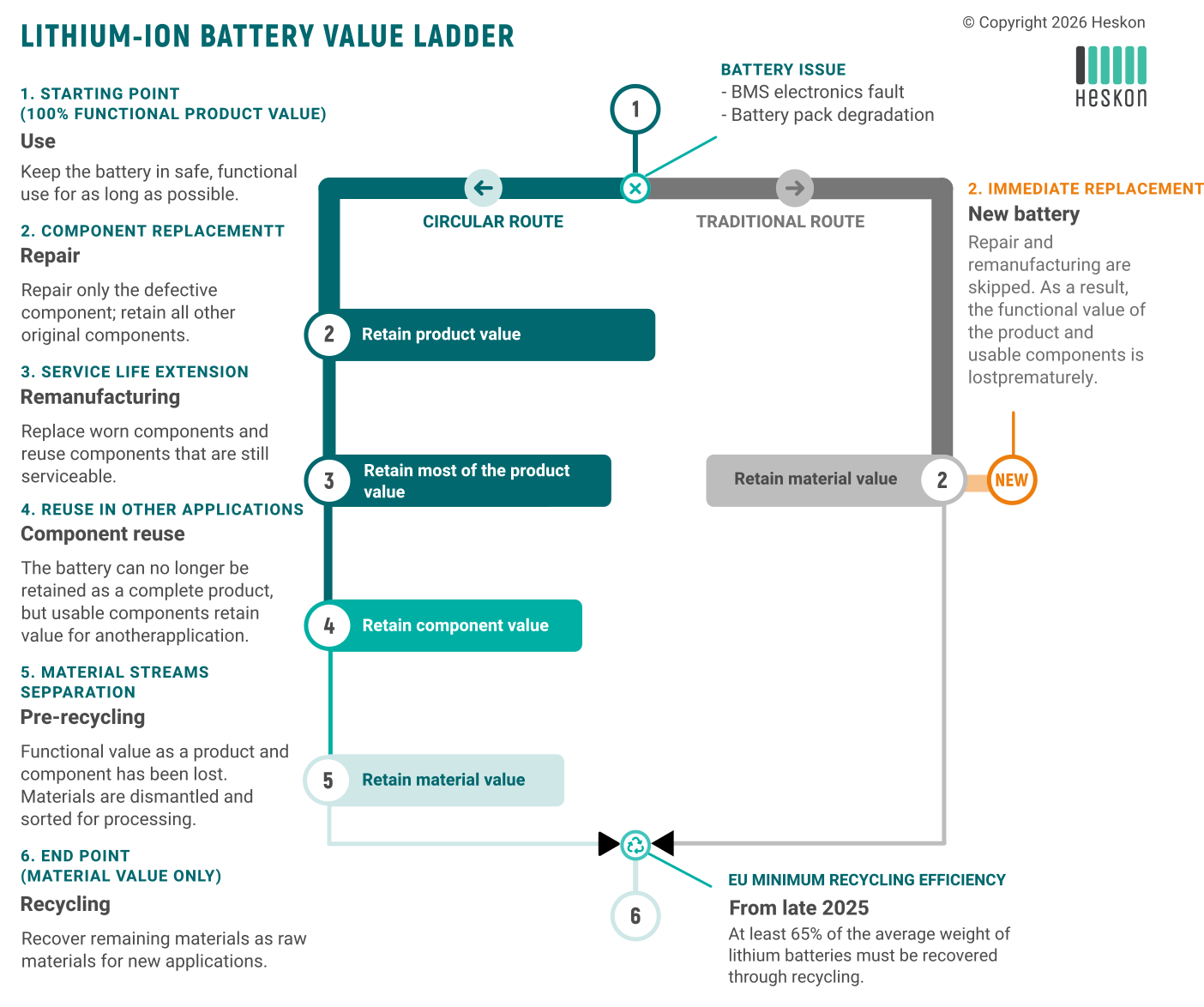
Heskon therefore focuses on retaining as much of a battery’s value as possible for as long as possible: first through repair, then, where necessary, through remanufacturing, followed by the recovery of usable components. Only when these options are no longer feasible are the remaining material streams separated and prepared for recycling.
The aim is to keep a battery as high as possible on the value ladder after a fault occurs, minimising the amount of value that is lost. Repairing or remanufacturing a battery can avoid or delay the need to produce an entirely new battery, along with the CO₂ emissions associated with its production.
Extending battery service life also supports the European shift towards greater repairability and the Right to Repair. The value ladder below illustrates how this approach works in practice.
How does a battery’s value change?
By value retention, we mean more than just the financial value of a battery. As long as a battery can be repaired or remanufactured, much of its functional product value is retained, including the battery casing, electronics and other usable components.
Further down the value ladder, more of this functional product value is lost, while reusable components can still retain value. At the recycling stage, the remaining value lies primarily in the materials that can be recovered for use as raw materials.
What role does battery recycling play?
Even within a circular battery strategy, recycling remains the necessary final step for recovering valuable raw materials and reintroducing them into the material cycle.
A sustainable battery strategy, however, starts before this final stage. By first assessing whether a battery can be restored and kept in use, more of its original product value can be retained. Recycling is therefore the necessary end point of the value ladder, but it is not the circular strategy as a whole.
From the end of 2025, the EU Battery Regulation (EU) 2023/1542 sets a minimum recycling efficiency of 65% for lithium batteries, meaning that at least 65% of their average weight must be recovered as material through recycling.
The environmental impact and costs of a circular battery strategy
A significant share of a lithium-ion battery’s environmental impact occurs during the production of the battery and its components. By repairing or remanufacturing a defective battery where possible, rather than replacing it entirely, the environmental impact associated with producing a new battery can be partly avoided.
How much CO₂ can be avoided by extending battery life?
Use the calculator below to estimate how much CO₂ emissions could be avoided if batteries within your organisation were repaired or remanufactured instead of being fully replaced.
How is this calculated?
This calculator provides an indicative comparison between full battery replacement, BMS repair and remanufacturing of a lithium-ion battery. A 500 Wh battery is used as the reference.
New battery – 42 kg CO₂-eq
The reference value is based on a CO₂ analysis by Bosch eBike Systems, conducted together with TÜV Rheinland and updated in 2024. For the reference configuration used in the analysis, 42 kg CO₂-eq is attributed to the 500 Wh battery.
According to the analysis, approximately 73% of the battery’s CO₂ impact is attributable to the battery cells, 12% to the battery casing and 4% to the cell holder. The cells therefore account for by far the largest share of the production impact.
Battery pack remanufacturing – 33 kg CO₂-eq
During remanufacturing, the battery cells are replaced while usable components such as the battery casing, electronics and other components are retained wherever possible. Since the new cells alone represent approximately 73% of the original impact, we use an indicative value of 33 kg CO₂-eq, including the remanufacturing process.
BMS repair – 2 kg CO₂-eq
During a BMS repair, the cell pack, battery casing and other usable components are retained. Only the electronic components that require attention are repaired or replaced. For this scenario, we use an indicative average value of 2 kg CO₂-eq.
Source and assumptions
Bosch eBike Systems & TÜV Rheinland (2024), CO₂ analysis of an eTrekking bike with Performance Line CX, PowerTube 500 and Kiox 300. Bosch reports 42 kg CO₂-eq for the battery, of which 73% is attributed to the cells, 12% to the battery casing and 4% to the cell holder.
The values for battery pack remanufacturing and BMS repair are Heskon modelling assumptions based on this component breakdown and on which components are replaced or retained during repair and remanufacturing. The actual CO₂ impact may vary depending on the battery and the work performed.
What is the economic value of extending battery life?
A circular battery strategy is about more than reducing environmental impact. By restoring a battery where possible after a fault occurs, the economic value of the existing product can also be retained for longer.
Sustainability and cost efficiency do not have to be opposing goals. By assessing each defective battery first, organisations can determine whether repair, remanufacturing or full replacement is actually necessary. This can help avoid unnecessary replacement costs. Full replacement may often be the simplest option, but over the battery’s total service life, it is not always the most cost-effective.
The economic benefits of extending battery life vary by application and battery type. Particularly when larger volumes of batteries are repaired or remanufactured on a regular basis, this approach can lead to a significantly different cost model.

Consider, for example, fleet owners that operate large numbers of batteries from the same product family each year. If some of these batteries can consistently be repaired or remanufactured instead of replaced, replacement costs across the entire fleet can be reduced significantly.
For organisations managing larger battery volumes, sustainable battery management is therefore also about Total Cost of Ownership: not only the cost of a new battery, but also how long the existing product value can continue to be used from both a technical and economic perspective before replacement becomes necessary.
How does circular battery management work in practice?
A circular battery strategy starts with knowing the actual condition of each battery. Heskon helps organisations assess incoming batteries and determine the most appropriate next step, rather than treating every defective battery in the same way.
Where possible, individual faults can then be repaired without replacing the entire battery. This helps retain valuable materials and components while making sustainable battery management a practical and cost-effective option.
- Diagnostics guide the next step: Heskon assesses the technical condition of each battery and determines whether repair, remanufacturing or another route is most appropriate.
- Reduce CO₂ impact and material use: avoiding or postponing full battery replacement helps reduce the environmental impact associated with producing new batteries.
- Lower Total Cost of Ownership: particularly for larger fleets, repairing or remanufacturing batteries can reduce replacement costs compared with routinely replacing the complete battery.
- Retain value until end of life: when further service life extension is no longer possible, usable components and materials are separated for reuse, recycling or further processing wherever possible.
Ready to develop a more sustainable battery strategy?
Tell us about your project using the form below. We’ll get in touch within 3–5 working days to discuss the possibilities.