


 Heskon B2B Revisie


Battery passport at a glance
What is a battery passport?
A battery passport is a digital record that brings together key information about a battery throughout its life cycle. It brings together key information such as the manufacturer, technical specifications, battery chemistry, use, service history and recycling. The requirements for the battery passport are laid down in the EU Battery Regulation 2023/1542.
What is the purpose of the battery passport?
The battery passport is part of the EU’s broader move towards Digital Product Passports. These digital records are intended to make information on sustainability, origin, composition and repairability easier to access throughout a product’s life cycle, supporting a more circular and sustainable use of products on the EU market.
When will the battery passport become mandatory?
From 18 February 2027, new LMT (light means of transport), EV batteries and industrial batteries with a capacity above 2 kWh must have a battery passport when they are placed on the EU market.
Who is responsible for the battery passport?
Responsibility lies with the economic operator that places the battery on the EU market. Depending on the supply chain, this may be the importer or the manufacturer when the battery is supplied directly to the European market. The responsible party must ensure that the information in the battery passport is accurate, complete and kept up to date.

What information does a battery passport contain?
The battery passport contains both general information about the battery type and information specific to the individual battery, including data added during its use.
Not all information is publicly accessible. Access to different parts of the battery passport depends on the party accessing it.
The EU Battery Regulation deliberately distinguishes between:
- publicly available information
- information available to parties with a legitimate interest
- information available only to regulatory authorities.
This provides transparency about batteries while protecting sensitive technical and commercial information.
1. Publicly available information
Some information in the battery passport is publicly accessible. This includes key information about the battery’s characteristics and sustainability-related data.
- General product information, including the manufacturer, battery model and warranty period.
- Key technical specifications, such as nominal capacity, voltage and expected service life.
- Information on material composition and sustainability, including critical raw materials, hazardous substances, recycled content and the carbon footprint.
2. Information for parties with a legitimate interest
Certain information is restricted to parties with a legitimate interest, for example where access is necessary for maintenance, repair or recycling.
- Detailed information on battery cells, materials and components relevant to maintenance or repair.
- Disassembly and safety information to support repair, remanufacturing and recycling.
- Information on the battery’s condition and use, such as available state-of-health data and charge-cycle information.
3. Information for regulatory authorities
Finally, the battery passport contains information that is accessible only to notified bodies, market surveillance authorities and the European Commission.
This includes conformity information and test results that can be used to demonstrate compliance with the requirements of the EU Battery Regulation.
Important: for the complete set of information requirements, see Annex XIII to Regulation (EU) 2023/1542.
When a battery comes to Heskon for repair, it provides an ideal opportunity to update the existing battery passport with relevant service information and link available test results and repair data to the individual battery.
Heskon does not take over responsibility for managing the battery passport. However, we can provide relevant service and test data to help the responsible economic operator maintain a reliable service history.
How will the battery passport be structured?
The key requirements for the battery passport are set out in the EU Battery Regulation. However, the practical implementation is still evolving. The figure below provides a schematic overview of how the new system will work from February 2027.
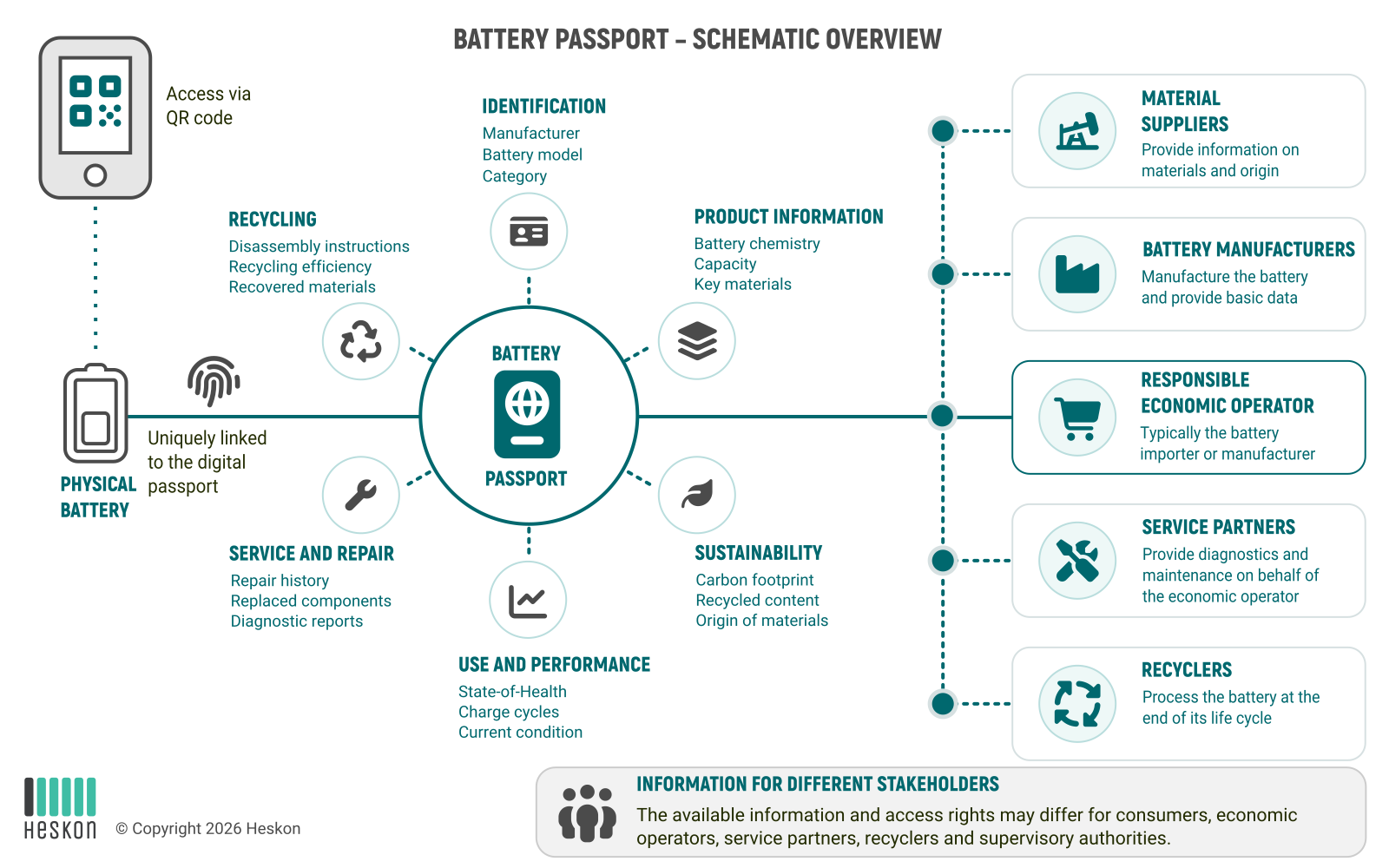
Battery manufacturers, software developers and industry organisations are currently developing digital solutions for the secure and standardised exchange of battery data.
The Regulation does not prescribe a specific software platform, nor does it require batteries to continuously transmit real-time data in order to keep the battery passport up to date.
The battery passport must, however, be accessible via a QR code, and its data must be structured and digitally searchable. Common data standards will also be needed to ensure that different systems can exchange information with one another.

Will there be a central battery passport?
In practice, the battery passport is unlikely to rely on a single central European software system. Instead, it is expected to operate as a network in which manufacturers, importers, service partners and recyclers can register and exchange data through different platforms.
Several organisations are already developing solutions, ranging from dedicated battery platforms to broader sustainability and product data systems.
Examples
Examples include Circulor, Siemens and DENSO. Battery passport solutions are also being developed within broader data ecosystems such as Catena-X and SAP.
Alongside commercial platforms, supporting initiatives are also emerging. BatteryPass-Ready, for example, is developing a test environment that allows manufacturers and software providers to assess whether their battery passport solutions meet the relevant requirements.
How can Heskon support your battery passport?
Service partners are generally not legally responsible for creating the battery passport or ensuring that all required information is complete. That responsibility lies with the economic operator that places the battery on the market or puts it into service.
Service partners can, however, play an important role in supplying and recording reliable battery data. Battery diagnostics, repair and remanufacturing can provide valuable data for the battery’s service history and traceability.
If the battery passport platform your organisation is connected to supports service data, Heskon can add relevant information about repairs, test results and other work to the battery’s service history.
Examples of how Heskon can support this include:
- Providing structured battery data:
Through API integrations, data on service and repair work, test results, replaced components and other relevant battery information can be added to the battery passport system your organisation uses. - Coordinating end-of-life processes:
Assessment of returned batteries, including disassembly and reporting back to the producer or importer on how the batteries were processed.
Book a free 15-minute consultation
Complete the form below and one of our experts will get in touch to arrange a no-obligation consultation.
"*" indicates required fields